
Postgic Blog · · 10 min read
Why Postgic Is Different from Other AI Social Media Generators
Most AI social media generators promise speed. Few are built for promotional output — posts that look ready to publish, fit each platform, and support real campaign workflows.
If you are comparing Postgic vs other AI tools like Canva AI, ChatGPT image generation, or general-purpose art apps, the difference is not just model quality. It is what happens before and after generation: prompt enhancement, platform sizing, feed previews, storage, and iteration built for marketers.
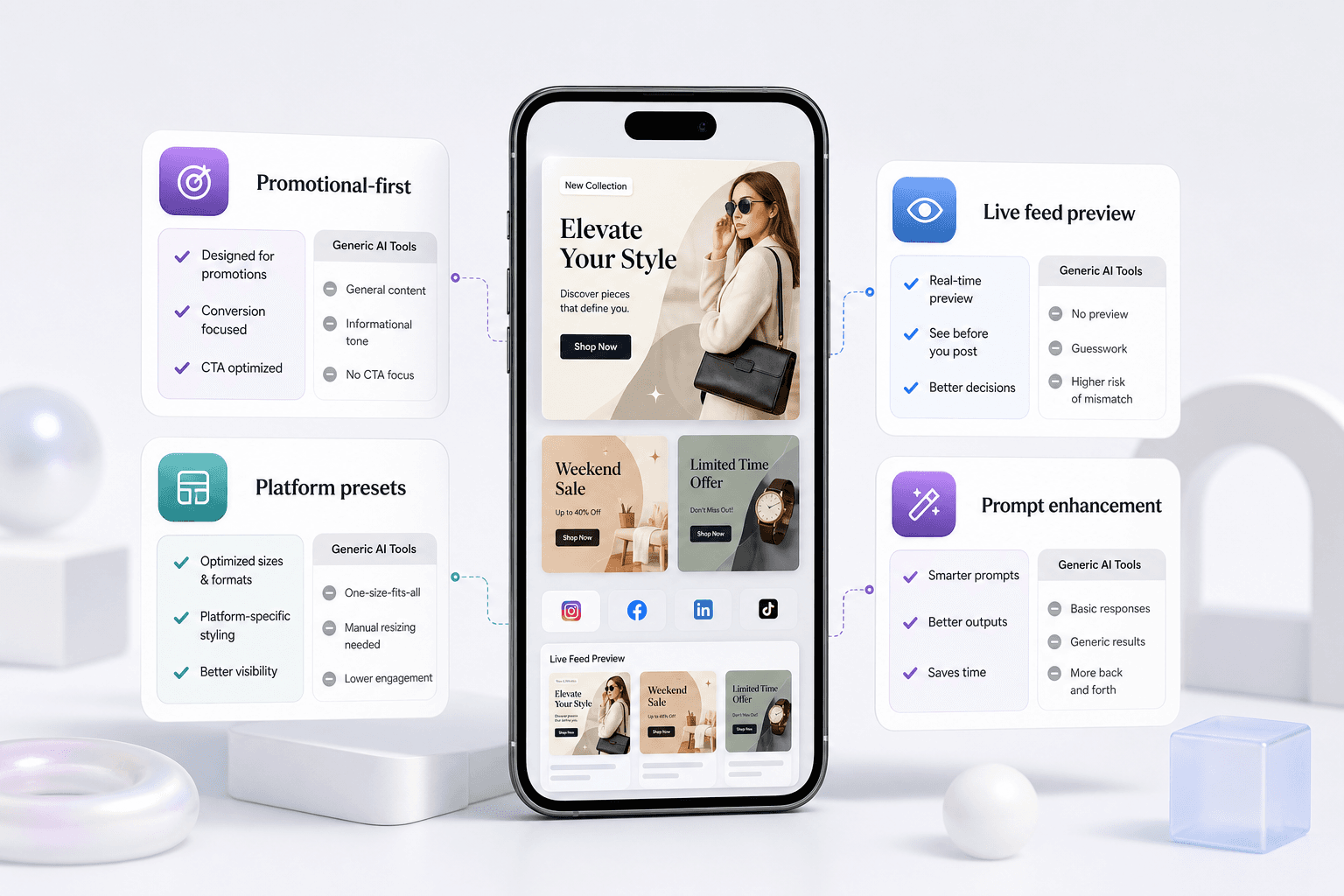
This guide explains why Postgic is different, where generic tools fall short, and how to choose the right AI promotional post generator for Instagram, Facebook, LinkedIn, and paid social campaigns.
What most AI social media tools get wrong
Generic AI creative tools usually optimize for one of these:
- Pretty images — artistic output with no marketing hierarchy
- Caption writing — text-only, no visual generation workflow
- Template editing — manual design with optional AI fill
- One-size output — single aspect ratio, cropped later per platform
That works for hobby content. It breaks down when you need volume, consistency, and conversion-focused creatives across multiple channels.
Common gaps in other tools:
| Gap | What happens in practice |
|---|---|
| No promotional intent | Images look good but lack clear offer, CTA space, or focal hierarchy |
| Weak prompt workflow | Users write vague prompts and get inconsistent results |
| Manual resizing | Extra steps in Canva or Figma for every platform variant |
| No feed context | You publish blind without seeing mobile feed framing |
| Scattered assets | Downloads live in folders with no generation history |
Postgic closes these gaps with a workflow designed for promotional social posts, not general illustration.
Why Postgic is different: 7 core advantages
1. Promotional-first generation
Postgic is tuned for marketing creatives — product launches, limited-time offers, app promos, webinar signups, and ad-style visuals.
Other AI tools often produce decorative art. Postgic prioritizes:
- readable visual hierarchy
- campaign-oriented composition
- outputs meant to drive clicks, signups, or purchases
That is the biggest reason Postgic vs ChatGPT social media comparisons favor Postgic for publishing velocity: ChatGPT can generate images, but it is not optimized for repeatable promotional workflows.
2. Built-in prompt enhancement (Gemini)
Most users do not write image-model prompts professionally. Postgic uses Gemini-powered prompt enhancement to expand short inputs like "summer sale, clean skincare brand" into detailed creative direction.
Compared with Postgic vs Canva AI:
- Canva helps inside templates; Postgic enhances prompts before generation
- Postgic reduces trial-and-error for non-designers
- Better prompts mean fewer wasted credits and faster iteration
3. Platform-specific aspect ratios
Every major network expects different formats. Postgic includes presets for:
- Instagram — square, portrait, story/reel
- Facebook — feed, square, story
- LinkedIn — landscape and square
- X, Pinterest, YouTube — timeline cards, pins, thumbnails
Generic AI social media post generators often export one size. Postgic lets you pick the format before generation, which prevents awkward crops and rework.
4. Realistic in-app feed previews
A creative that looks fine in a desktop editor can fail in a mobile feed. Postgic includes device-style previews so you can evaluate composition, text placement, and visual weight before publishing.
This is a practical differentiator most AI art tools and chat-based image generators do not offer.
5. Campaign workflow, not one-off images
Postgic supports a full create → refine → reuse loop:
- Enter prompt, goal, and style
- Generate platform-ready creative
- Modify or regenerate variations
- Store assets in your account
- Download and publish
Tools like ChatGPT or standalone image apps are strong for single outputs. Postgic is built for repeatable campaign production.
6. Multiple premium image and video models
Postgic connects to production-grade models through Fal AI, including:
- Image: Nano Banana, GPT Image 2, Ideogram V3, Recraft, and Flux
- Video: WAN 2.2 (Growth and Scale), Kling 2.5 Turbo Pro (Scale)
Many competitors lock you into one model or one style. Postgic gives teams model choice without switching platforms.
7. A free trial built for real evaluation
You can test output quality before your first charge. Every Postgic plan starts with a 1-day free trial that includes 10 trial credits, prompt enhancement, image generation, and cloud storage. A card is required to start, and you are not charged if you cancel before the trial ends.
That matters for SEO visitors comparing best AI promotional post generator options: you can validate fit on real campaign work before committing budget.
Postgic vs other AI tools: quick comparison
| Capability | Postgic | ChatGPT | Canva AI | Generic AI art apps |
|---|---|---|---|---|
| Promotional post focus | Yes | Partial | Partial | No |
| Prompt enhancement | Built-in (Gemini) | Chat-based | Template-led | Rare |
| Platform aspect presets | Yes | No | Yes (manual) | No |
| Mobile feed preview | Yes | No | Limited | No |
| Video generation | Yes (Growth and Scale) | Limited | Add-ons | Varies |
| Generation history & storage | Yes | Limited | Yes | Varies |
| Free trial before you pay | Yes (1 day, card required) | Varies | Limited | Varies |
If your goal is daily social publishing and ad creative testing, Postgic's workflow usually wins on speed and campaign fit.
Postgic vs Canva AI: when each tool makes sense
Canva AI is excellent when you want template control, brand kits inside a design editor, and manual layout adjustments.
Postgic is stronger when you want:
- faster prompt-to-publish generation
- less manual canvas work
- platform presets selected upfront
- promotional output without building every layout yourself
Many teams use Canva for final polish and Postgic for high-volume creative generation. For solo founders and lean marketing teams, Postgic often replaces hours of template editing.
Postgic vs ChatGPT for social media posts
ChatGPT is a general AI assistant. It can draft captions and create images, but it lacks a dedicated social publishing workflow:
- no native platform size presets
- no feed preview for Instagram or LinkedIn
- no structured campaign inputs (goal, style, format)
- no centralized creative library for marketing assets
For one-off experiments, ChatGPT is fine. For consistent promotional output, Postgic is purpose-built.
Who Postgic is best for
Postgic is a strong fit if you are:
- a creator publishing promos across multiple platforms
- a SaaS or e-commerce marketer testing ad angles weekly
- a solo founder without a design team
- an agency producing high-volume campaign variants
- anyone comparing AI social media generator tools for marketing ROI
Postgic is less ideal if you need complex manual design systems, print layouts, or non-social brand collateral as your primary output.
SEO checklist: how this page helps your search strategy
If you are building organic traffic around comparison keywords, align pages like this with search intent:
- Target comparison queries — "Postgic vs Canva AI," "Postgic vs ChatGPT social media," "best AI promotional post generator"
- Use clear H2 sections — one intent per section (features, comparison, use cases, FAQ)
- Add internal links — connect to product, pricing, and related guides
- Show concrete differentiators — previews, presets, prompt enhancement, storage
- Answer objections — trial limits, commercial use, platform support
Related reading:
- How to Create Facebook Posts with AI (2026 Guide)
- How to Create LinkedIn Posts with AI (2026 Guide)
- How to Create Instagram Posts with AI (2026 Guide)
- Free AI Social Media Post Generator (2026 Guide)
Frequently asked questions
Is Postgic only for images?
No. Postgic supports promotional images on all plans and video generation on the Growth and Scale plans. It is built for short-form social and ad creatives.
How is Postgic different from a free AI art generator?
Free art generators focus on illustration. Postgic focuses on promotional posts with campaign inputs, platform sizing, and publishing workflow.
Can I use Postgic for paid ads?
Postgic is designed for marketing and promotional use cases. Review current terms before large-scale paid media deployment.
Does Postgic replace Canva completely?
Not always. Postgic replaces the slow parts of social creative production. Teams that need deep manual layout control may still use Canva for final edits.
What makes Postgic better for SEO content teams?
Postgic helps SEO and content teams ship visual assets faster for landing pages, lead magnets, and social distribution — with consistent formats and reusable generation history.
Is there a free way to compare Postgic with other tools?
Yes. Start the 1-day free trial (10 trial credits, card required to begin) and compare output quality against your current workflow side by side. Cancel before the trial ends and you are not charged.
Final thoughts: why Postgic is different
The AI social media generator market is crowded. Most tools generate images. Few optimize the full path from idea to platform-ready promotional creative.
Why Postgic is different comes down to focus:
- promotional output, not generic art
- prompt intelligence before generation
- platform-aware sizing and previews
- storage and iteration for campaign velocity
If you are evaluating tools in 2026, do not ask only "Can it make an image?" Ask "Can it help me publish better posts, faster, across every channel?"
Ready to see the difference? Start your free trial on Postgic and generate your first platform-ready promotional post in minutes. Compare plans on pricing when you are ready to scale.